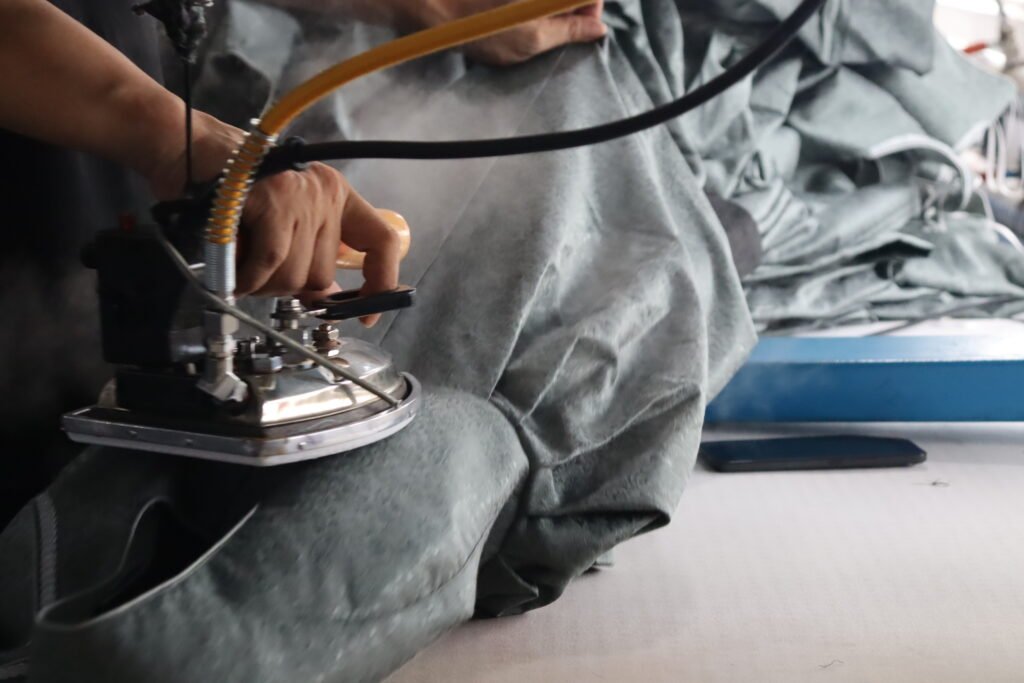
Elevating Garment Quality from the Inside Out
In the high-stakes arena of global fashion manufacturing, where “fast fashion” often prioritizes speed over substance, there exists a quiet revolution in quality control. For brands that refuse to compromise on fit, finish, and longevity, the difference between a mass-produced commodity and a premium garment is often defined by a single, often overlooked stage: Ironing.
At Seaflower Garment, we view ironing not merely as a menial chore or a final touch-up, but as a critical manufacturing discipline. It is the bridge between raw fabric and a finished product that exudes luxury, confidence, and structural integrity. For our discerning European clientele—brands that set the gold standard for style and durability—mastering the dual pillars of Under Pressing and Final Pressing is not an option; it is the very foundation of our partnership.
This article delves deep into the meticulous world of professional garment pressing, exploring how temperature, pressure, steam, and technique converge to create apparel that stands the test of time.
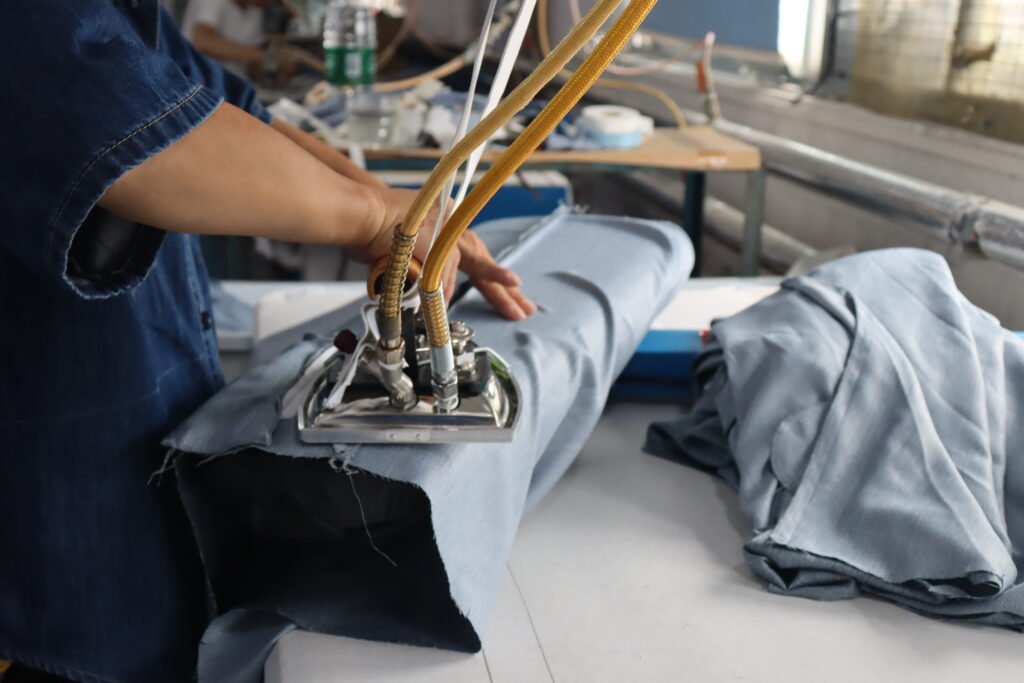
The Unsung Architecture: Understanding Under Pressing
If a garment were a building, Under Pressing would be its concrete and steel framework. It is the process of pressing seams, darts, and panels at every stage of assembly—before the garment is fully constructed. In the rush of production, many factories skip this step, opting to “clean it up” at the end. However, this approach is a fatal flaw for premium brands.
1. The Physics of “Settling”
When fabric is cut and sewn, the needle creates tension within the yarns. Under Pressing releases this tension, allowing the stitches to “settle” into the fabric. This process is technically known as “heat setting.” By applying heat and moisture (steam) to a newly sewn seam, we stabilize the fibers, ensuring that the garment maintains its shape through years of wear and washing. A dart pressed flat during assembly will remain sharp; a dart sewn and left to be pressed later will often pucker or bubble, as the tension pulls the fabric unevenly.
2. The Direction of the Grain
Fabric has a “grain line”—the direction in which the threads are woven. If a seam is not pressed open or flat correctly, it distorts the grain line, causing the finished garment to hang crookedly. For a European blazer, where the lapel must roll perfectly and the sleeve must hang at a precise angle, Under Pressing is the only way to lock in that geometric precision.
3. Durability Through Reduction
Seams that are not pressed during assembly are prone to “grinning”—a term used when the stitches pull apart under stress, revealing the fabric underneath. Under Pressing reinforces the seam by distributing the stress load across the entire seam allowance, rather than concentrating it on the stitch line. This is particularly critical for high-tension areas like the armholes of a shirt or the waistband of trousers.
4. Efficiency in the Long Run
Paradoxically, spending time on Under Pressing actually speeds up production. When a seam is flat and stable, the operator can sew the next panel with absolute accuracy. Misaligned seams are the number one cause of rework in factories. By investing in Under Pressing, we eliminate rework, ensuring that every piece that leaves our floor is a first-quality product.
The Final Reveal: Mastering Final Ironing
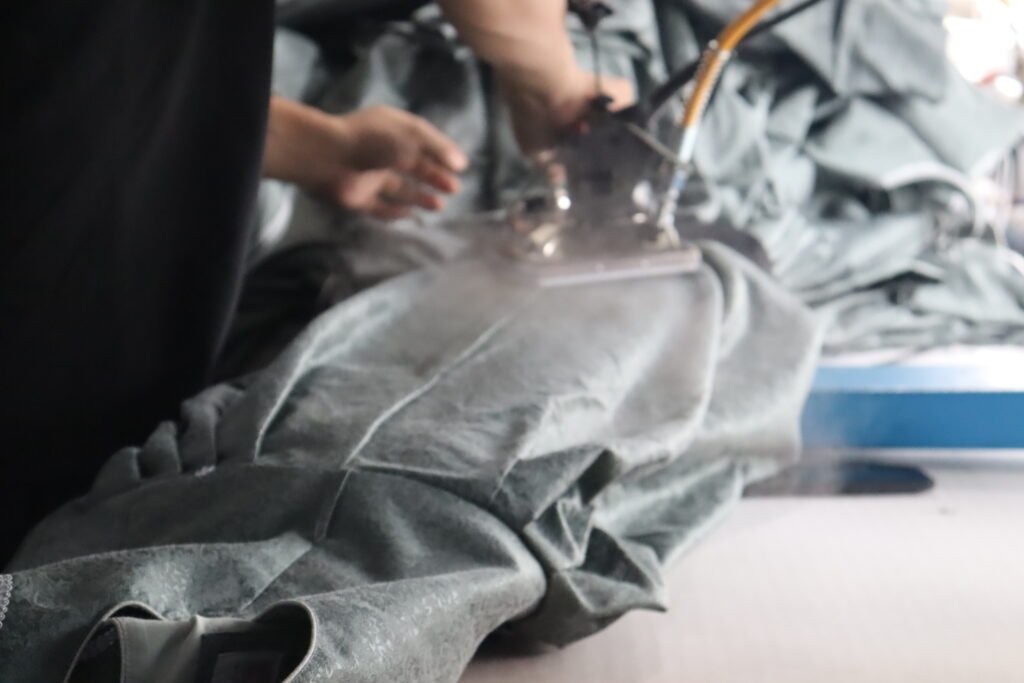
Once the garment is fully assembled, it moves to the final frontier: Final Pressing. This is the stage where the garment sheds its “work-in-progress” appearance and transforms into a retail-ready masterpiece. It is here that the collaboration between human skill and advanced machinery reaches its peak.
1. The Steam Press: Precision Engineering
Unlike a domestic iron, the industrial steam presses used at Seaflower Garment are marvels of engineering. They utilize high-pressure steam (often exceeding 4 bar) and vacuum technology. The steam penetrates deep into the fibers, relaxing them, while the vacuum instantly sucks the moisture out, drying the fabric in its new, flat state.
For example, pressing a men’s dress shirt requires a specialized “buck”—a padded form shaped like a human shoulder or chest. The operator places the shirt over the buck, lowers the press, and activates the steam and vacuum. The result is a crisp, 3D shape that no hand iron can replicate.
2. The Human Element: Reading the Fabric
While machines provide the power, it is the operator who provides the intelligence. Every fabric—from a heavyweight Italian wool to a delicate Japanese silk—requires a unique “recipe” of heat and pressure.
- Wool & Cashmere: These fibers require high steam and pressure but low direct heat to avoid “shine” (an unwanted glossy patch caused by crushed fibers). Our operators use a press cloth to act as a buffer.
- Cotton & Linen: These natural fibers are resilient and require high heat to break down their structure and create a sharp, crisp finish.
- Synthetics (Polyester/Acetate): These fabrics melt under high heat. Final pressing for synthetics is a delicate dance of low heat and high steam, requiring the operator to “lift” the garment away from the heat source as soon as the steam hits.
At Seaflower Garment, our pressers undergo rigorous training to recognize these nuances. They know that the gray wool fabric in our featured image requires a different touch than a bright white cotton poplin.
3. The “Retail Ready” Standard Ironing
For European brands, the presentation is everything. A garment must look perfect on the hanger to attract the consumer. Final Pressing ensures that:
- Collars and cuffs are symmetrical and flat.
- Pleats in skirts and trousers are sharp and hang vertically.
- Shoulder pads sit correctly, creating the desired silhouette.
- Hems lie flat without “waviness.”
This level of finish is what justifies the premium price tag. It signals to the customer that this garment was made with care, not just assembled.
The Seaflower Advantage: Technology and Training
Why do European brands trust Seaflower Garment with their most critical lines? Because we treat ironing as a specialized craft, not a production afterthought.
Investment in Equipment
We have invested heavily in state-of-the-art pressing equipment from leading European manufacturers. Our machines feature digital temperature controls, programmable steam cycles, and ergonomic designs that reduce operator fatigue. We also maintain a strict maintenance schedule, because a leaking steam pipe or a malfunctioning vacuum can ruin a batch of fabric in minutes.
The “Zero Defect” Mindset
Our quality control (QC) team works in tandem with our pressing department. We have implemented a “three-check” system:
- In-process Check: Ensuring Under Pressing is done correctly before the garment moves to the next sewing station.
- Pre-Press Check: Inspecting for loose threads or stains that could be “set” into the fabric by the heat.
- Final Audit: A final inspection after pressing to ensure the garment meets the brand’s exacting standards.
Sustainability in Pressing
In today’s eco-conscious market, sustainability is key. Modern pressing technology allows us to recycle condensed water and recover heat, reducing our environmental footprint. Furthermore, by ensuring that garments hold their shape and look good for longer, we contribute to a more sustainable fashion cycle—discouraging the “wear once and discard” mentality.
Conclusion: The Details That Define Excellence
In the grand scheme of garment manufacturing, it is easy to get lost in the complexity of pattern making or the speed of cutting. But at the end of the day, when a customer picks up a jacket in a boutique in Paris, Milan, or London, they judge its quality by how it feels, how it hangs, and how crisp it looks.
Ironing is the silent ambassador of quality. It is the difference between a garment that looks “cheap” and one that looks “haute couture.”
At Seaflower Garment, we understand that Under Pressing and Final Pressing are not just steps in a workflow. They are the culmination of our technical expertise, our respect for the fabric, and our commitment to our clients. For brands that demand perfection, we don’t just make clothes—we engineer them. We press them. We perfect them.
Because in the world of high-end fashion, excellence is not an accident; it is an iron-clad guarantee.
Click to our Products, you will know the difference between these standards.
Other standard in our factory? You will understand after this video.